Knowledge, Understanding... Reconciliation
by Linc Kesler, Associate Professor Emeritus, Institute for Critical Indigenous Studies & English
If you feel that you have lived in Canada for many years but still know little about Indigenous peoples or history, you are not alone, nor is it an accident. For more than a century it was government policy to suppress information about Indigenous people and cultural expression and to exclude all but the most cursory information from school curricula. When I arrived at UBC in 2003, with the exception of a few truly expert faculty, it seemed that very few people were at all aware of Indigenous issues, and the Indigenous people I met did not describe the campus as a friendly place.
Over the next twenty years, many of us have worked very hard to change that situation—to bring greater visibility to Indigenous people on campus and to create better circumstances for Indigenous students, faculty, and staff, more functional curricula, and better relationships with Indigenous communities. The developments have been pervasive and extensive. Most are embedded in units, but some have also resulted in changes that you can easily see.
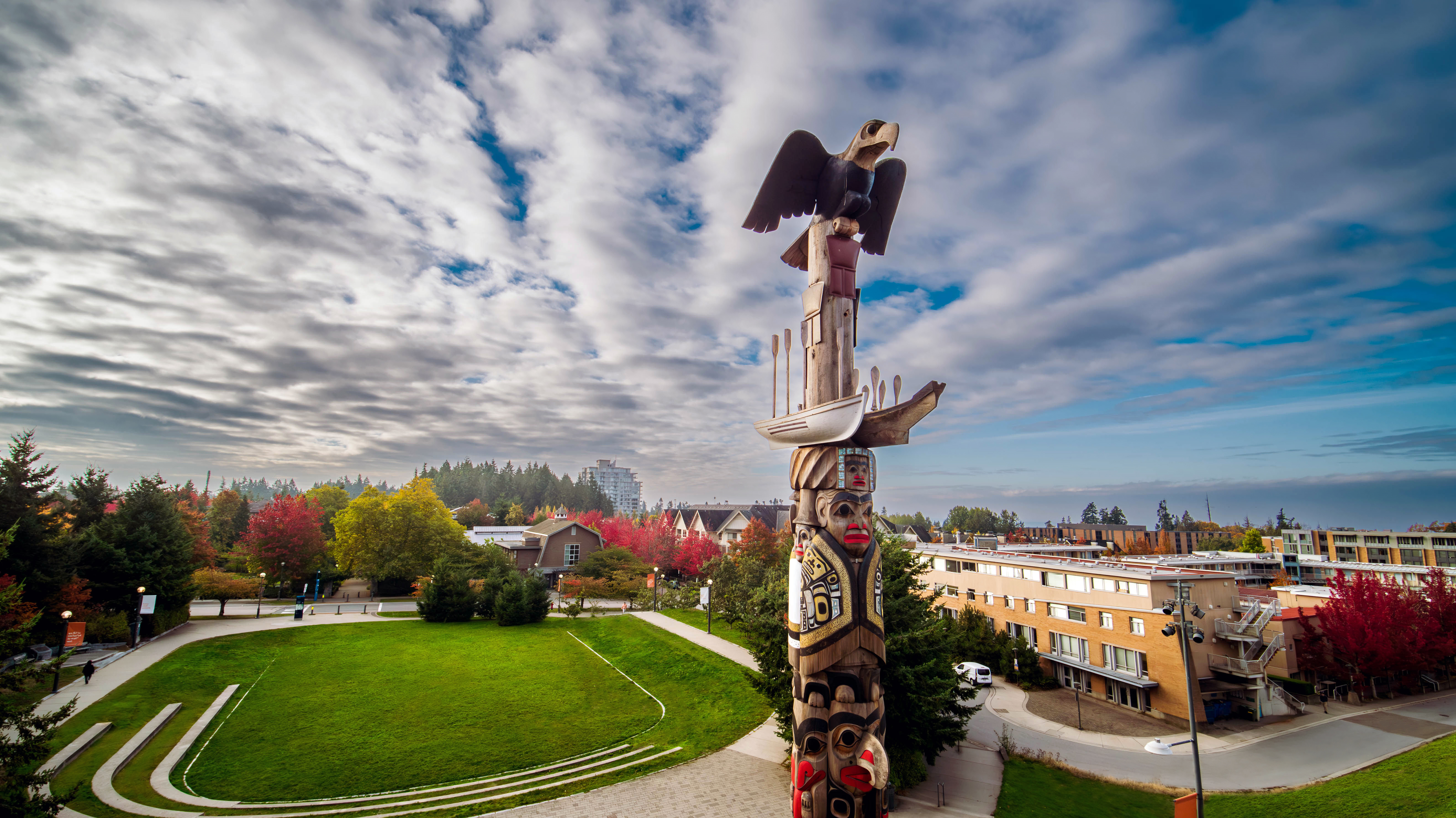
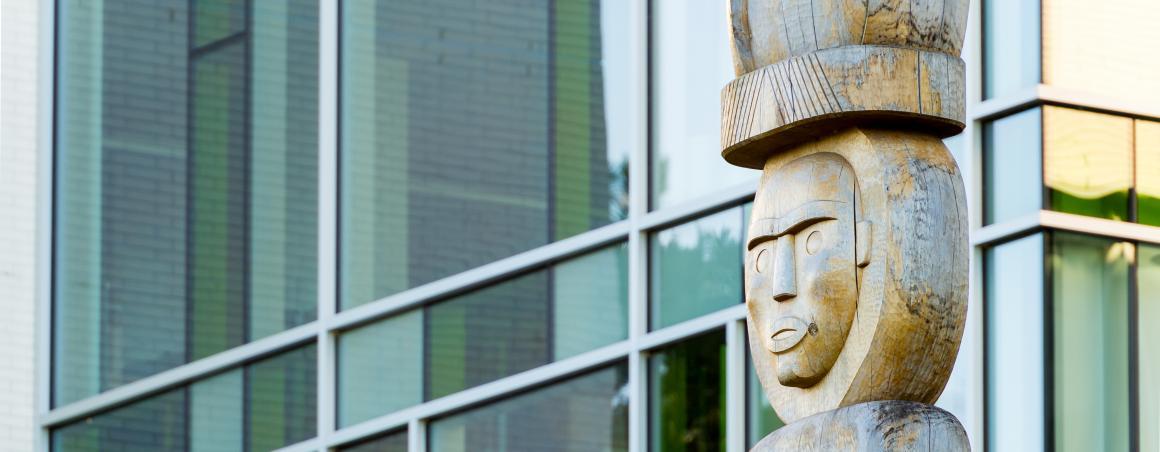
One of our strategies was to increase visual markers of Indigenous presence on campus, eventually including Musqueam building names and street signs, but beginning with west coast traditional mnemonic carvings. Some have been at UBC for decades, including the many located at MOA, and ones, such as Ellen Neal’s 1948 Victory Through Honour pole, that have a rich local history (you can read about it on this website created for the UBC Centennial). Among more recent additions are the qiyəplenəxʷ (Capilano) statue north of the Allard School of Law, the Musqueam sʔi:ɬqəy̓ qeqən post opposite the Alumni Centre, and the Reconciliation Pole carved by Haida chief 7idansuu (James Hart) at the south end of the Main Mall. That pole was pulled into place with ropes by hundreds of people on April 1, 2017. More about the pole and a video of the event may be found here. The iconography of Reconciliation Pole addresses the history of the Indian residential schools, and its carving and placement were coincident with the opening of the UBC Indian Residential School History and Dialogue Centre (IRSHDC) located between the Koerner Library and IK Barber Learning Centre. That opening event, attended by Indian residential school survivors and UBC and community leaders, also included a statement of apology read by President Santa Ono for the University’s complicity in that and other oppressive systems. More about the Centre and its opening is available here.
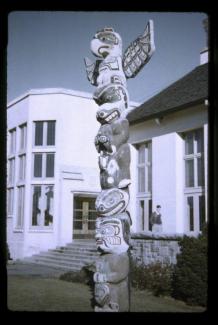
MOA archives.
The IRSHDC was developed through years of work in conjunction with the Indian Residential School Survivors Society and the Truth and Reconciliation Commission of Canada. The TRC was formed in 2008 as part of the settlement to the largest class-action lawsuit in Canadian history, brought by former students and survivors of the residential schools against the crown and the churches that operated the schools. The schools were one of the government policies that operated, largely away from the awareness of most Canadians, to deliberately undermine the viability of Indigenous communities and cultures. For more than a hundred years, Indigenous children, often at a very young age, were forcibly removed from their families and placed in the schools, often for years, where they were forbidden to speak their native languages, denied contact with their families, and subject to systematic malnutrition and harsh regimes of psychological, physical, and often sexual abuse. Many students died in the schools, with mortality rates at times in excess of 60%. Those who survived often left deeply traumatized, unable to return to their communities, and left to struggle with their trauma on unforgiving city streets. Those who did return were often alienated and passed on the patterns of abuse that had formed their lives to their children. The trauma of the schools is intergenerational, and their legacy is still very much with us today; it is the suffering of those students that we commemorate each year on Orange Shirt Day.
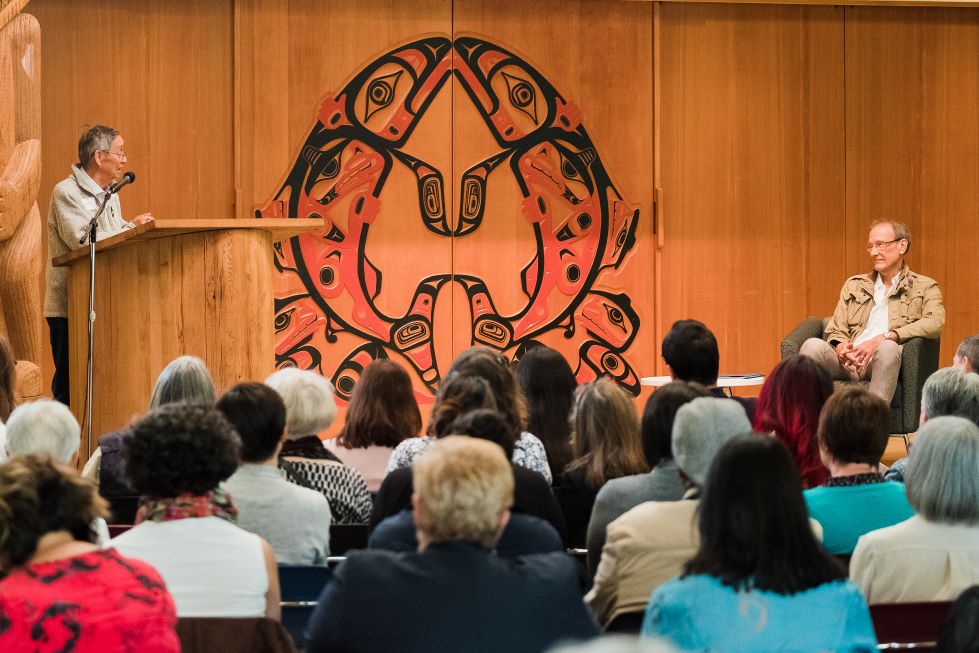
The residential schools were only one among many destabilizing practices pursued by governments, but they are perhaps the most easily understood, since the abuses they involved were perpetrated on defenseless children who had done nothing to deserve them. On November 8, 2011, after attending an Indian Residential School Survivors Society event on the North Shore, we worked with the IRSSS to conduct a day-long event in the UBC Longhouse to inform campus leaders about the residential school history, but also learn about how some units on campus were working to integrate understanding of it and other matters into their curricula. More than 300 campus leaders and community members attended for a long and difficult day, though it ended on a positive note—and it changed the dialogue on campus substantially: rather than having to constantly make the case for the need to address Indigenous concerns, we were now able to talk more directly about how they might be effectively addressed. The video record of that day is available here.
When the TRC conducted its last major event on the west coast in September 2013, UBC conducted many events, including the most-attended exhibition in the history of the Belkin Gallery and exhibits at MOA and other locations. UBC also suspended classes on the first day of the event, the only university in Canada to do so, so that students and faculty could attend the event and hear survivor testimony. Thousands participated, some staying to the end of the day to cheer when, in a darkened auditorium, President Stephen Toope announced UBC’s intention to work towards the formation of the IRSHDC at UBC so that the history of the schools would not be forgotten and that knowledge of it form a core part of a UBC education.
The term “Reconciliation” is very ambivalent for many Indigenous people, suggesting for some the idea that the injuries of the past—and those that continue today—can somehow be overcome and “made right.” That is perhaps not really the most functional aspiration. Understanding what has happened here, recognizing our different histories for what they are, and working for better relationships are perhaps more realistic goals. If you would like to know more about these and other issues, including land (why, for instance, we acknowledge Musqueam territory as “unceded”) and the legal landscape that has transformed relations (two of the most influential in Canadian history coming from Musqueam), please see Indigenous Foundations, a website designed to provide concise information on a range of Indigenous topics.
Also consider watching two films, Kanesatake (on the Oka crisis) and Finding Dawn (on missing and murdered Indigenous women and girls) on open access of the National Film Board website: they are key entry points to understanding a broad range of issues. And if you are on campus, be sure to visit the IRSHDC, talk to people, and explore its advanced interactive displays.
After so many years of silence, there is now a growing body of high-quality information by both Indigenous and non-Indigenous scholars available—from UBC and many other institutions. There is a lot to know and understand for the prospect of better relations that can follow.